

For more than 40 years, Nina Bohdanets lived in Volnovakha. She worked there as a teacher of Ukrainian language and literature, taught children, raised her sons, and made a home for herself. After the full-scale war began, she lived through heavy shelling, the battle for the city, and evacuation from the temporarily occupied territory. While abroad, Ms. Nina learned that her apartment in Volnovakha had first been added to a list of so-called “ownerless” property. Then, in the spring of 2026, it was declared the “property” of the occupation municipality.
Nina Bohdanets told Volnovakha.City how she found out that her home had effectively been seized, what happened to the apartment after the occupation, and why she decided to officially record the loss of her property in Ukraine.
“In Volnovakha, I had respect, authority, and esteem”
Before the full-scale war, Ms. Nina’s life was closely tied to Volnovakha and to education. She worked as a teacher of Ukrainian language and literature and as a teacher-methodologist. She held the highest qualification category and the title “Excellence in Education of Ukraine.”
“A great many of my students went on to study Ukrainian language and literature. I counted once — it was around forty. I had respect, authority, and esteem among the parents. I loved Volnovakha, its people, my neighbors.
It’s very pleasant when you go to the hospital or even to the shop and everyone knows you and greets you. Such simple things were so pleasant,” Ms. Nina says.
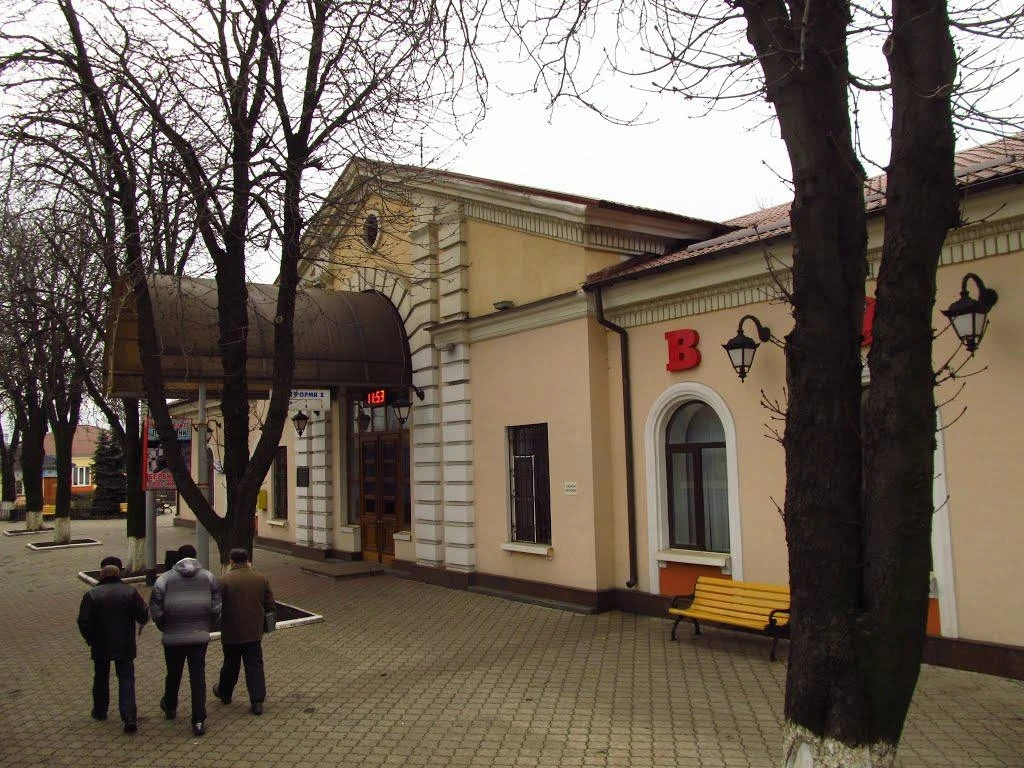 Volnovakha railway station
Life during the fighting
Ms. Nina was in Volnovakha when the full-scale war began. During the active fighting, she sheltered in a basement with other residents.
“If it weren’t for the basements in our apartment buildings, so many more people would have died. Shells were falling, and everything shook nonstop from the explosions. I felt constant fear,” she recalls.
One night she decided to go up to her apartment. The building no longer had windows, and the temperature outside was below freezing. Ms. Nina fell asleep so deeply that she woke only after sunrise.
That morning she saw that the church that stood near her home was essentially gone.
“I look out the window and the church is gone. It had still been standing, with its bell towers and domes damaged. People said, ‘They burned the church.’ I don’t know exactly when it happened — at night or in the morning,” the teacher says.
On March 21, she and her son left Volnovakha through temporarily occupied Dokuchaievsk.
“I couldn’t bear to see all of this anymore. Rumors had already started that people’s homes were being searched. I was afraid, because many people knew about my pro-Ukrainian stance.”
After she left, acquaintances looked after the apartment
After leaving, Ms. Nina kept receiving news about her apartment from acquaintances who had stayed in Volnovakha.
Her building, No. 25 on Mendeleieva Street, was damaged, like many of the neighboring ones. The apartments had no windows, and the heating systems were damaged by the frost. After the city was occupied, repair work began in the building.
Ms. Nina’s apartment survived, although the balcony was damaged. Friends and acquaintances helped keep an eye on it and managed to save some of her personal belongings.
Family photographs were especially precious to her.
“I was lucky that my friends took photographs, numerous certificates of merit and diplomas, and some other things out of my apartment. And kind people brought them to Europe.”
In this way, Ms. Nina stayed informed about what was happening to her home, even though she could no longer return to it herself.


“Back then, I didn’t understand what an ownerless apartment was”
In the spring of 2024, Ms. Nina received a message from an acquaintance that changed everything.
“She sends me a copy of a printed register — apartments declared ownerless. This was in May. And my apartment is on it. I had no idea what ‘ownerless’ even meant back then,” Ms. Nina says.
According to her, the acquaintance showed copies of the apartment documents to representatives of the occupation authorities and told them that the owner was alive.
“She showed them that the owner was alive and who was registered there — two sons and a husband. They said everything was fine, but the bills had to be paid. She began paying for heating and other utilities. At that point I sort of calmed down.”
However, in the spring of 2026, a new notice appeared on the apartment door.
“Your apartment is the property of the Volnovakha municipality”
An acquaintance sent Ms. Nina a photo of the notice.
“They hung a piece of paper on the door saying that your apartment is the property of the Volnovakha municipality. Anyone with access was asked to open the door on May 25. If the door was locked, it would be broken open. It said a commission would come,” Ms. Nina says.
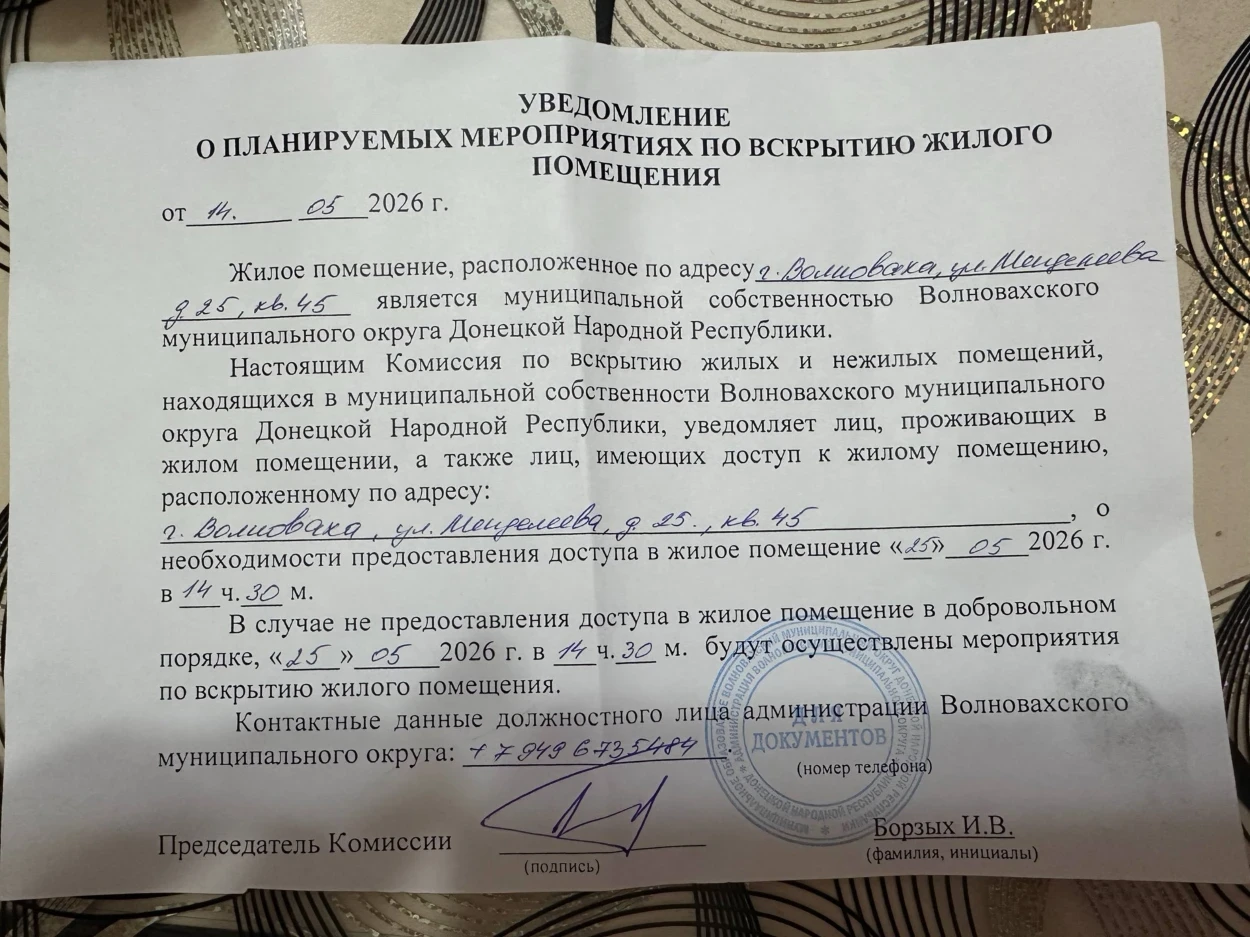 The notice from Ms. Nina’s door Photo: provided by the heroine exclusively to Volnovakha.CityФото: Volnovakha.City
On May 25, the acquaintance opened the apartment for representatives of the so-called commission. According to Ms. Nina, they inspected the apartment and drew up a report, a copy of which she later received.
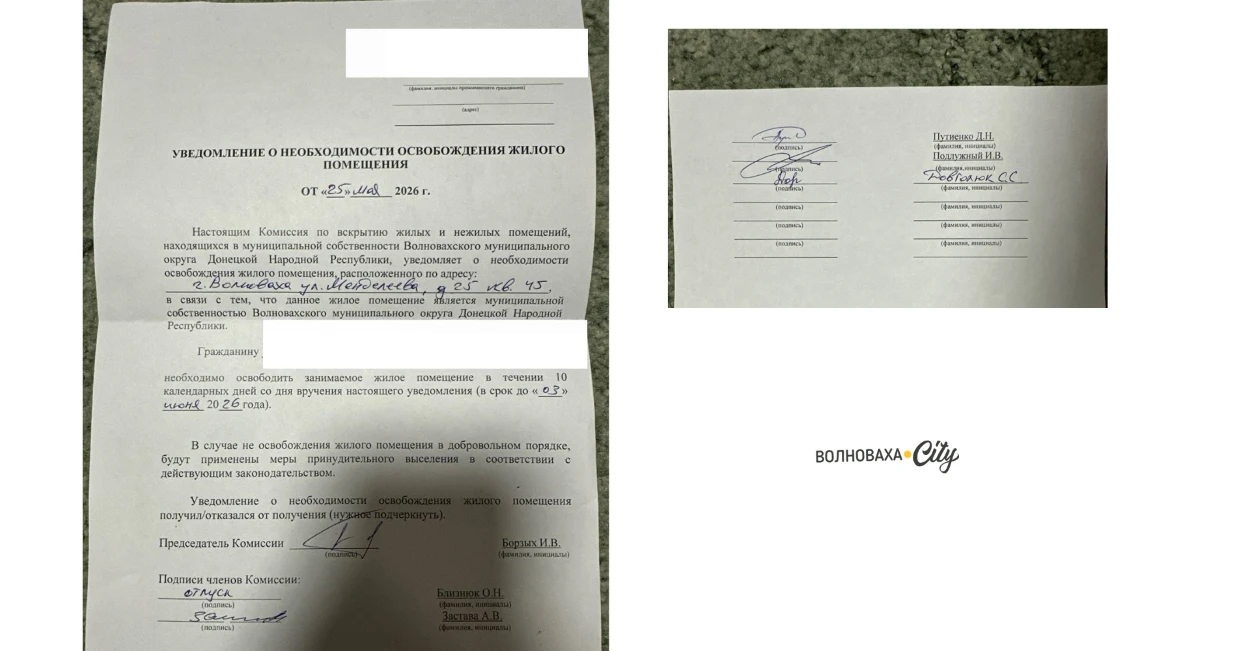 The apartment Photo: provided by the heroine exclusively to Volnovakha.CityФото: Volnovakha.City
Based on her acquaintance’s account, Ms. Nina says two men stood by the apartment, ready to break down the door if no one opened it.
Ms. Nina says she had no intention of traveling to temporarily occupied Volnovakha to re-register her home under Russian rules.
“Many people went there, came back, and tried to re-register something. But for that, you need a Russian passport. Obviously, I didn’t go anywhere, and I won’t.”
Thereafter, Ms. Nina asked acquaintances to take out of the apartment whatever could still be saved. She allowed neighbors to take some of her belongings.
“I told one neighbor, ‘Take whatever you want.’ It was easier for me knowing that people I know would take these things—so they wouldn’t go to the occupiers.”
Ms. Nina does not know why her apartment in particular became the target of such a decision by the occupation authorities.
“The neighbors were outraged. They said they’d never heard of anything like it being taken this way. In our entrance there are apartments where nobody lives at all, and no one even knows where the owners are or whether they’re alive. Why my apartment? I don’t know.”
According to Ms. Nina, in September 2026, so-called “municipal employees” confiscated the apartment keys from her neighbors and announced that new residents would be moving in.
“I was left homeless at 68”
“I was left without a home. At 68. I gave 43 years of my life to Volnovakha. It hurts so much. It’s very hard,” Ms. Nina says.
After the decision by the occupation authorities, Ms. Nina decided to officially document what had happened to her apartment. At the end of May, she contacted the Ukrainian Parliament Commissioner for Human Rights.
“It was important to me that at least some trace remained. That it was recorded.”
Later, an investigator contacted her.
“An investigator called me and said that the so-called nationalization of the apartment had been entered into the Unified Register of Pre-Trial Investigations.”
In the Netherlands, she continues to teach children Ukrainian
Ms. Nina now lives in the Netherlands. She says she is grateful to the country for giving refuge to Ukrainians after the full-scale war began.
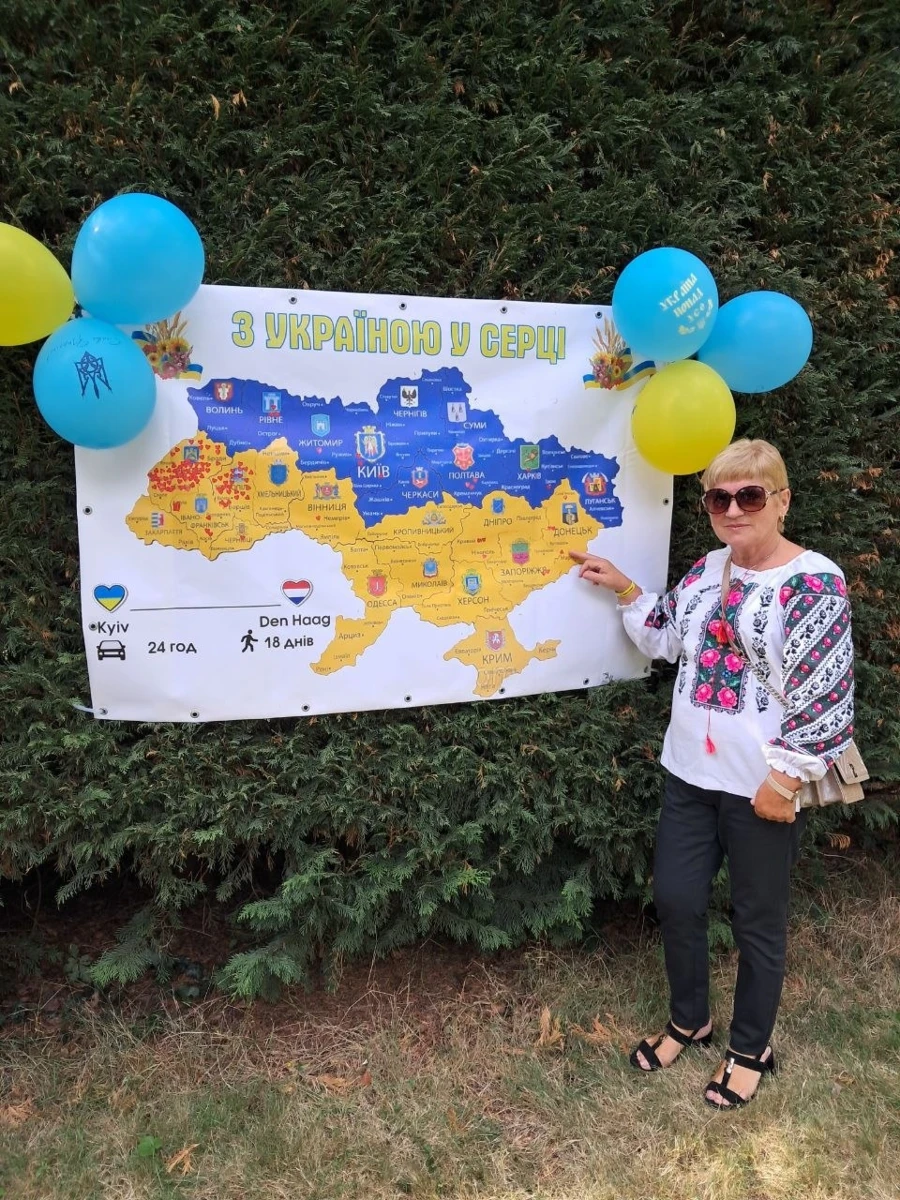 “The Hague. At the ‘With Ukraine in My Heart’ celebration for Ukrainians, talking about the Donetsk region.” Photo: provided by the heroine
Even at 68, the teacher continues to work with children. At the request of Ukrainian parents, she helps schoolchildren keep up their Ukrainian.
“I study Ukrainian with several children — third, fourth, and fifth grade. So that at least they don’t forget it, so they keep reading and writing.”
The teacher has seen how children who left Ukraine at a younger age can lose their connection with the Ukrainian language.
Despite living thousands of kilometers from Volnovakha, Ms. Nina keeps following what is happening in her hometown. And she still hopes to return.
“There is hope. I will walk into that apartment again,” Ms. Nina says with confidence.
What to do if the occupiers have seized your home
Oksana Chekmenova, a practicing humanitarian lawyer, commented on the seizure of housing in the occupied territories and offered recommendations for Ukrainians who have lost access to their property. (Her words follow.)
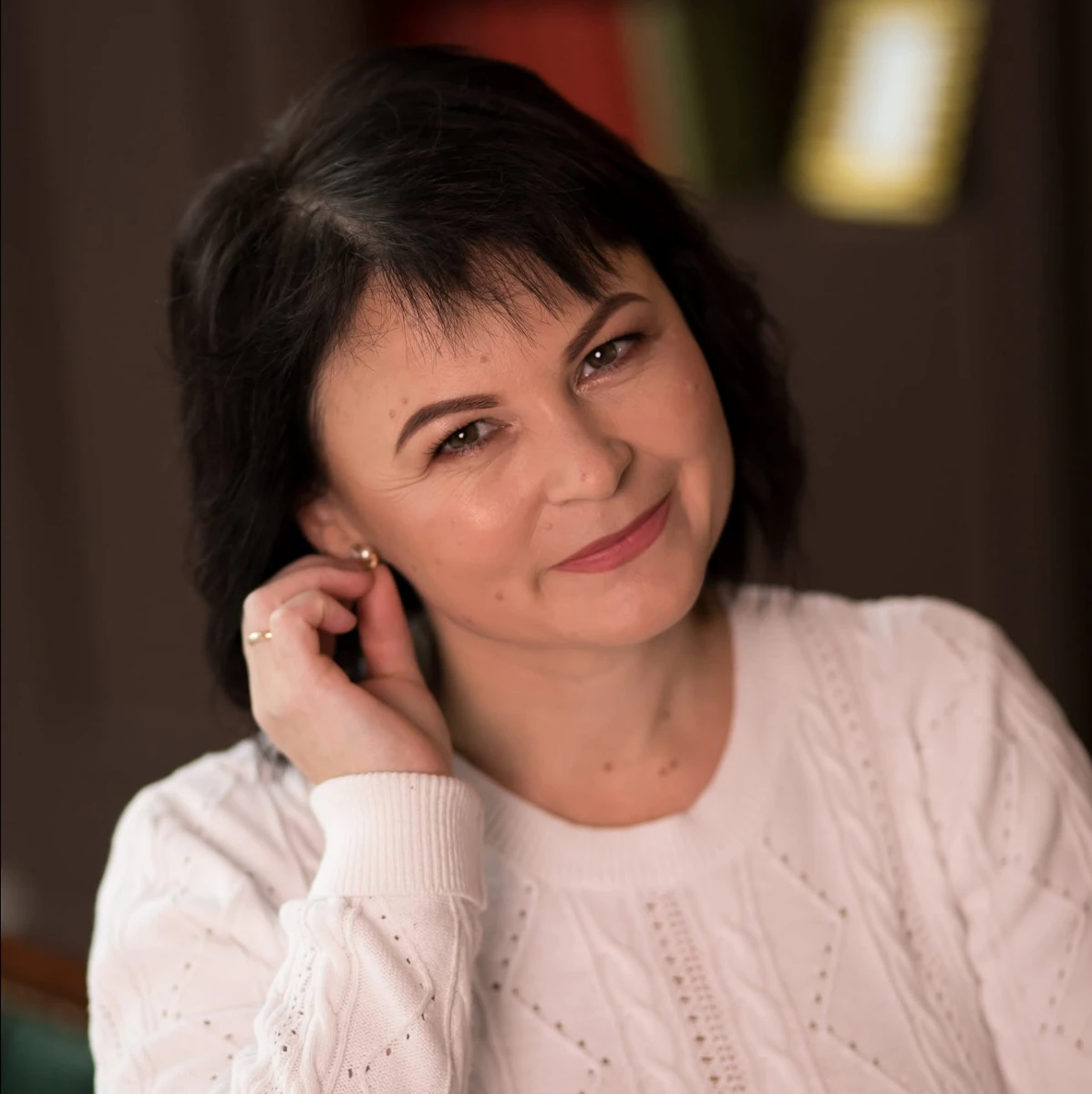 Oksana ChekmenovaФото: Oksana Chekmenova
— Ms. Nina’s story is yet another confirmation that Ukrainians are being deprived of ownership of homes left in the occupied territory. I am from the Donetsk region myself, and I can clearly picture the neat two-story apartment building where she lived—I visited relatives on Mendeleieva Street many times. It is a great pity that Russian "nationalization" is also aimed at making Ukrainians not even want to return, because someone is already living in their homes.
The first question I usually hear is whether it is worth going there to fix the situation. There is no answer to that question. Will you make it there (in every sense)? Do you have the originals? Can you hold out there for six months or more? Do you have the money for such a difficult journey? Is there anyone there to support you? Will it even work? In reality, the risks of such a trip are so high, and the consequences so unpredictable and more likely negative, that simply voicing these questions is enough for a person to decide for themselves whether to go. There are many known cases—in Mariupol, for example—where living in one’s own home did not prevent occupation "nationalization."
As for the consequences of the seizure of Ukrainian housing under occupation, it should be remembered that all transactions and actions carried out in the occupied territory regarding Ukrainians’ homes—whether "nationalization" or a sale—that do not comply with Ukrainian law are not valid in Ukraine. In turn, transactions under Ukrainian law, including gifts, inheritance, and sales of housing located in the occupied territory, are not valid there, in the occupied territory. This is because neither warring party recognizes the legitimacy of the other’s documents.
More on the guarantee of property rights and the legal regime of property in the temporarily occupied territory can be found in Article 11 of the Law of Ukraine “On Ensuring the Rights and Freedoms of Citizens and the Legal Regime on the Temporarily Occupied Territory of Ukraine.” Unfortunately, the new version of the Law, which takes effect on October 22, 2026, does not contain a similar provision.
The provisions of the Civil Code of Ukraine continue to guarantee the inviolability of property rights. Under the Code, no one may be unlawfully deprived of ownership of their home. Any Russian laws or decisions of occupation administrations on the “nationalization” of property or declaring it "ownerless" are entirely null and void from a legal standpoint, including under international approaches.
Reparations are precisely the mechanism for protecting property rights that people in a similar situation can count on. In 2026, the Register of Damage for Ukraine is already operating as part of the international compensation mechanism, designed to collect information on damage, loss, and injury caused by Russia’s full-scale invasion of Ukraine. Those who have lost housing in the occupied territories can file claims in at least three categories:
- loss of housing or place of residence (regardless of ownership or the basis of residence) — Category A3.3;
- loss of access to or control over real estate in the temporarily occupied territories (including residential and non-residential property, for owners) — Category A3.6;
- damage to or destruction of residential real estate (for homeowners) — Category A3.1.
Claims in these and other categories are submitted through the Diia portal. I advise reading the FAQ on the Register’s website and preparing the necessary evidence so that your submission goes through on the first try.
It is impossible to predict reparation payments down to the month and year, but they will certainly come. Proof of this is the rapid development of the international compensation mechanism: in December 2025, 35 states and the European Union signed the Convention establishing the Claims Commission under the auspices of the Council of Europe, and the next step will be the creation of a reparations fund.
Entering information about the loss of housing through destruction, damage, or “nationalization” into the Unified Register of Pre-Trial Investigations, as Ms. Nina did, is the right step, since an extract from this register is one of the official pieces of evidence that the owner’s rights have been violated. Such crimes should be reported to the National Police by any available means. For example, you can file a crime report with Ukrainian law enforcement completely remotely from abroad through the National Police’s official online appeals system.
At present, Ukraine’s national legal system has no regulation in force providing payments to owners of destroyed, damaged, or inaccessible housing in the temporarily occupied territories. The Procedure for providing assistance to resolve the housing issue for certain categories of internally displaced persons who lived in the temporarily occupied territory, approved by Cabinet of Ministers Resolution No. 1176 of September 22, 2025, is intended to support only certain veterans with war-related disabilities, who did not necessarily own housing but lived in the occupied territory.
However the international compensation mechanism develops and national legislation on support for owners of housing left in the occupied territory changes, the first step should definitely be verifying your documents: completing inheritance, checking originals, and checking whether your rights are recorded in the current State Register of Property Rights to Real Estate. Up-to-date ownership records are the key to being able to protect your rights and receive reparations or compensation.
For many humanitarian human rights organizations in Ukraine, protecting property rights—whether restoring lost documents or helping people apply to the Register of Damage for Ukraine—is a priority. Don’t face these questions alone: seek professional help, for example through the PravoVsim legal aid platform or the free legal aid providers listed on the Register of Damage website.